


Sarah Martise
Art Teacher
Phone:
614-832-3741
Email:
Address:
17W364 Red Oak Avenue
Addison, IL 60101
A Bit About Me
Welcome to my art teaching journey! Inspired by my own art teacher in third grade, I have dedicated over 20 years to teaching art in various settings. I’ve had the privilege of working with students from all backgrounds, ages, and abilities, and my passion for inspiring them to explore their creativity only grows stronger.
The Beauty of Art Is The Expression of the Artist's Perspective
One Assignment, Three Interpretations


As educators, our job is to instill confidence and fostering a love for learning in every student, regardless of their background. We recognize and celebrate the unique traits each individual brings, creating a powerful environment where everyone can succeed.
Check Out Some of My Students' Work!
Elementary


Middle School


High School


Lesson Sample
Eric Carle Collage 1st Grade
Performance Based Objectives:
-
Students will explore the life and works of Eric Carle.
-
Students will create paintings using multiple texture tools.
-
Students will cut their texture paintings to create an animal collage with setting.
Vocabulary: Eric Carle, author, illustrator, setting, texture, collage
Procedures:
-
Gather students on carpets.
-
Ask students previous knowledge of Eric Carle.
-
Show students Carle books and explain that he is an author and illustrator that uses texture to make collages.
-
Read one of Carle’s books, and point out the various textures.
-
Explain to students that they will be creating their own Eric Carle collages. They will be choosing an animal to create with a setting around it. For today they will be completing sketches with color.
-
Independent work time: hand out sketchbooks and have students complete sketches of animals and finish them off with colored pencil. Make sure they have a list of colors they will need by the end of class.
-
At the end of class: Have volunteers collect pencils and sketchbooks.
Day 2
-
Gather students on carpets.
-
Review vocabulary.
-
Explain to students that they will be watching a movie of Eric Carle doing his artwork. Tell them to pay close attention to how he creates his textures and collage.
-
Show “Eric Carle Picture Writer” (found in the library).
-
If time allows: demonstrate how to paint texture using a sponge and have students edit their sketches.
Day 3 - Day 6
-
Gather students on the carpets.
-
Review vocabulary.
-
Explain to students that they will be painting multiple texture paintings today to use for their collage.
Remind them that the paintings are just to show different textures, and we will be cutting them up to make the pieces of the collage later.
-
If not completed on Day 2: demonstrate how to paint texture using sponge and brush. (days 4-6 demonstrate carpet, toothbrushes, and forks).
-
Dismiss students to cover their tables with newspaper and put on paint shirts.
-
Independent work time: have student volunteers hand out brushes, sponges, paint, paper, pencils (names), and water containers. As students finish their paintings and place them on the drying rack make sure to give them another paper.
-
At the end of class: have student volunteers collect supplies and students place their pieces on the drying rack and throw away newspaper.
Day 7-11
-
Gather students on the carpets.
-
Review vocabulary.
-
Explain to students that they will be using their texture paintings to cut and create their animal collages.
-
Demonstrate making the collage (draw each part on the color that they want, cut it with scissors, then glue down.)
-
Independent work time: Have student volunteers hand out supplies and walk around and help as needed.
-
At the end of class: have student volunteers collect supplies and students place their pieces on the drying rack.
Day 12
Same as days 7-11, except students will be finishing their pieces with sharpie for details.
Day 13
-
Gather students on carpets.
-
Review vocabulary.
-
Tell students that they will be finishing their projects and completing writings and rubrics. Show them that they will be taping them to the back, as they always have. As they finish they will hand them in on the chair and work on Free Choice until it is time to share them.
-
Independent work time: Have student volunteers hand out projects, crayons, and tape. Walk around and help students read through and complete writings and rubrics.
-
As students are finishing up: When you notice that many of the students are finished or close to finished (should have at least 15min left of class), gather those that are done on the carpet to share their projects. If you have 15min or less, tell them they will be giving 1 compliment to each student, but if more time remains they can do 2. They have done this before so they should know what to do.
Hold up student works one by one, while student volunteers raise their hands to compliment the work. Make sure to tell them to raise their hand only if they haven’t had a turn, so everyone gets one. As the pickings get low you can have them do more. Mark in the grade book every time they participate with an appropriate compliment so that you have record to grade them from.
6. At the end of class, have volunteers collect what is left on the tables and dismiss students to line up.
How Do You
Assess Art?
Simple to understand rubrics for both self evaluation and grading. It keeps the expectations clear, while leaving room to grade for the individuality of the students.
.png)
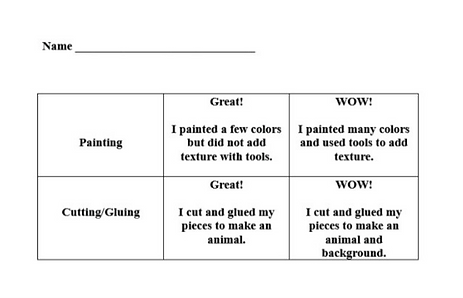
Writings that allows students to show what they have learned, while giving context to the work for viewers.


